How to Design Reliable AI Agent Guardrails for Real Work
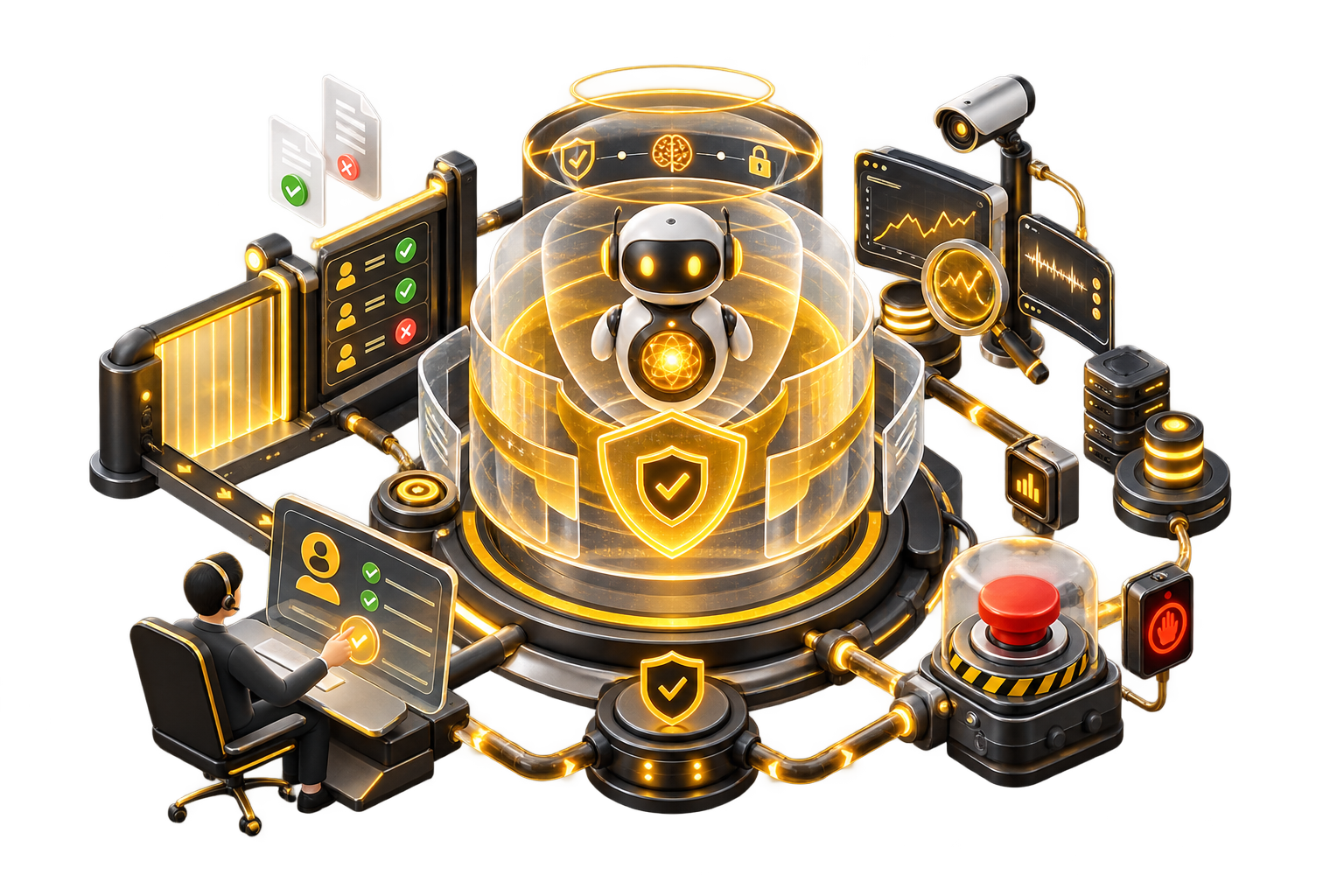
A production guardrail architecture for permissions, approvals, data boundaries, monitoring, evaluation, and recovery.
An agent becomes valuable when it can act. The same capability creates risk: it can misunderstand intent, use the wrong tool, expose sensitive context, or complete the wrong action with confidence. Guardrails are the operating architecture that lets useful autonomy exist without unlimited freedom.
OpenAI recommends layered controls around inputs, tools, outputs, and human intervention. Anthropic frames trustworthy agents around human control, alignment, security, transparency, and privacy. A production design turns those principles into concrete controls.
Constrain capability, not just language
Prompt instructions matter, but permissions are stronger than promises. Give each tool the minimum access needed, use separate credentials for read and write operations, restrict data scopes, validate every argument, and block actions outside an allowlist. The model should never be the only enforcement layer.
- Apply least privilege to tools, data, and environments.
- Validate tool inputs with deterministic code.
- Keep secrets out of model-visible context whenever possible.
Place approval where consequences change
Too many confirmations train users to approve without thinking. Put approval gates at consequence boundaries: sending a message, publishing content, spending money, deleting data, changing access, or making a commitment. Show the proposed action and important parameters so the reviewer can make an informed decision.
- Preview the recipient, scope, data, and cost.
- Make denial and revision easy.
- Record who approved what and when.
Evaluate the whole trajectory
Agent quality cannot be judged from the final answer alone. Review decisions, tool calls, intermediate state, recovery behavior, and escalation. Build test sets from real failures, edge cases, and high-risk scenarios. Re-run evaluations whenever models, tools, prompts, or policies change.
- Test normal, adversarial, ambiguous, and incomplete inputs.
- Score policy compliance alongside answer quality.
- Maintain kill switches, rate limits, and incident runbooks.
Final perspective
Reliable agents are deliberately limited systems. They know what they may do, what they must never do, when a person decides, and how failure will be understood.
Research references
This TivroTech article synthesizes the following primary and practitioner guidance with our own practical analysis: