AI Agents vs Workflow Automation: What Should Your Business Build?
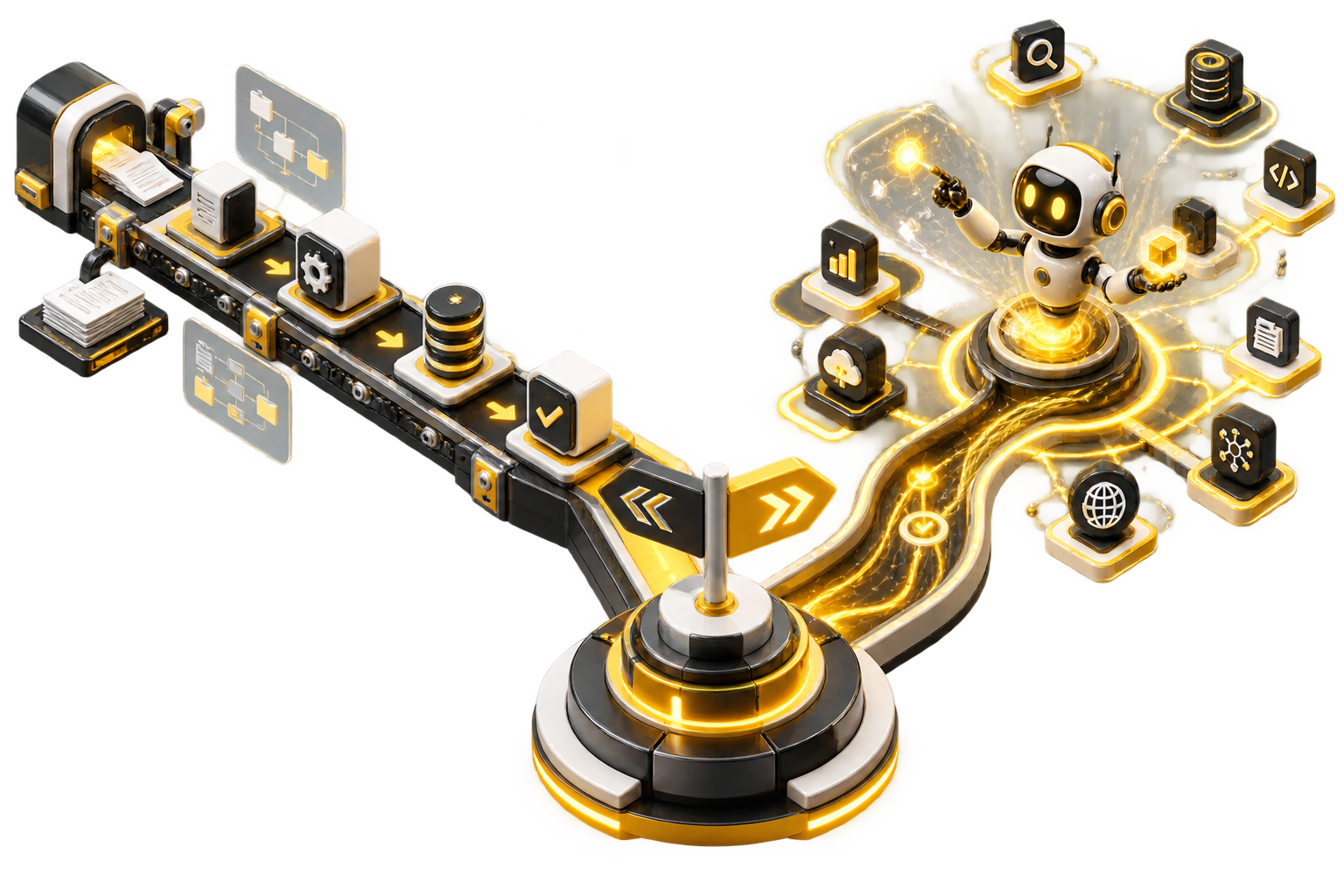
A practical framework for choosing deterministic automation, AI-assisted workflows, or autonomous agents without adding unnecessary complexity.
AI agent is becoming a label for almost every automated experience. That makes the buying decision harder, not easier. The useful question is not whether an agent sounds more advanced. It is whether the work contains enough ambiguity, judgment, and changing context to justify one.
OpenAI describes agents as systems that independently accomplish tasks by using a model, tools, and instructions. Anthropic distinguishes predictable workflows from systems that dynamically decide how to proceed. Together, those ideas give leaders a clean rule: choose the simplest architecture that can reliably do the job.
Start with the shape of the work
Map the process before selecting technology. Deterministic automation is strongest when inputs are structured, rules are stable, and valid paths can be described in advance. AI-assisted workflows fit bounded language tasks such as classification, extraction, or drafting. An agent earns its complexity when it must plan across steps, select tools, recover from partial failure, and know when to ask for help.
- Use rules for repeatable decisions with clear inputs.
- Use AI inside a workflow for bounded language or perception tasks.
- Use an agent only when adaptive sequencing creates real value.
Design control before autonomy
The business impact of a wrong action should determine oversight. A summary can run with light review. A system that refunds money, changes customer records, or sends external communications needs explicit permissions, approval gates, and audit logs. Autonomy is not a switch; it is a set of carefully scoped capabilities.
- Separate read permissions from write permissions.
- Require approval for irreversible or externally visible actions.
- Define stop conditions, escalation paths, and a safe fallback.
Prove value in a narrow slice
Begin with one high-volume workflow and record the baseline for time, cost, accuracy, rework, and customer impact. Pilot the smallest viable version, review exceptions, and expand only when quality is stable. This keeps the business case grounded in outcomes instead of demonstration value.
- Measure the old process before building the new one.
- Review exceptions, not only average performance.
- Scale after reliability and ownership are clear.
Final perspective
Choose rules where rules work, add AI where judgment is bounded, and introduce agents where adaptive execution genuinely changes the economics of the process.
Research references
This TivroTech article synthesizes the following primary and practitioner guidance with our own practical analysis: